Opener hums but the door does not move
This often means a stripped gear or a disconnected rail carriage. The gear or carriage is replaced, then the door is tested under load.
When the remote clicks and nothing happens, the fault can sit in the remote, the photo-eye sensors, the gears, or the door itself. We trace the fault step by step instead of swapping parts at random.
Tell us what happens when you press the button: humming, blinking lights, a door that moves a few inches, or nothing at all. Those details point to the fault.
Call (615) 805-0680 →Most repairs typically cost $129-$299. You will hear the price before any work starts.
Open Monday to Friday, 8am to 6pm.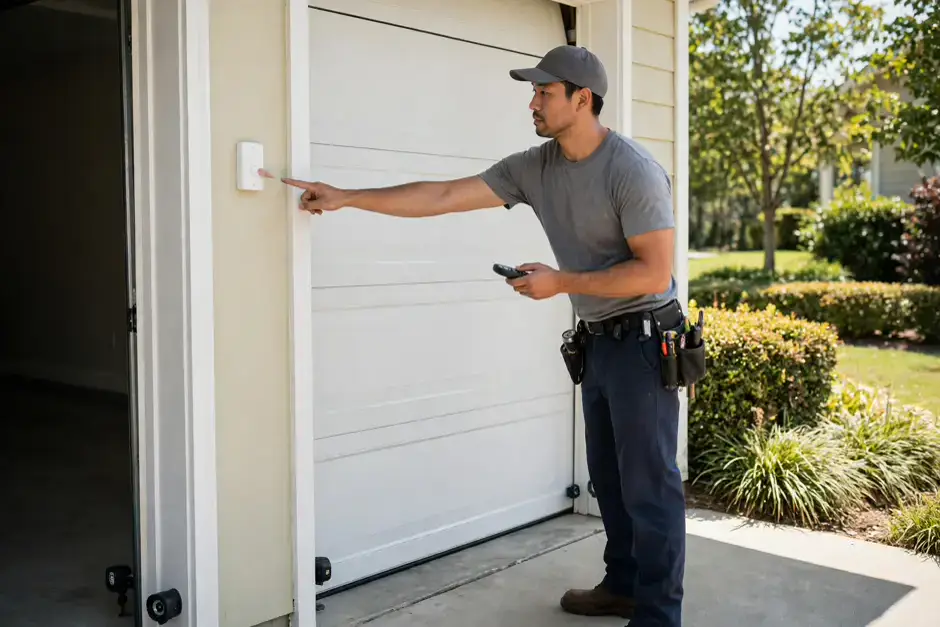
A garage door opener is the motor unit, rail, and controls that lift and lower the door. When it will not respond, the cause is often a dead remote battery, blocked photo-eye sensors, a worn gear, or a door that is too heavy for the motor because of a spring problem.
Before you book, check the obvious: fresh remote batteries, a wall control that still works, and sensors near the floor that are clean and lined up. If the wall button works but the remote does not, the remote or its programming is the likely fault. Goodlettsville Garage Door Rescue works across Goodlettsville, TN 37072, from the Rivergate Parkway side of town to homes off US-31W, and we also cover opener calls in East Goodlettsville and visits in Dry Creek Farms. Because a heavy door can burn out an opener, we also check whether a spring is the real problem and whether a remote needs reprogramming. For model guidance, Chamberlain's opener lineup shows how chain and belt drives differ.
An opener visit starts with the door, not just the motor. A healthy opener on a heavy or dragging door will fail again, so the door, the rail, and the controls are all checked. Skipping that door check is how a new part fails again within weeks.
We test the remote, wall control, keypad, sensors, and motor in turn, so the faulty part is found before anything is replaced.
Chain or belt tension, the rail, sprockets, and gears are checked for wear, slack, or stripped teeth.
Photo-eye sensors are aligned and cleaned, and the auto-reverse and force settings are tested.
Open and close limits are set so the door stops where it should, without slamming or straining.
Opener faults can look alike, so the visit follows a fixed order: controls first, then sensors, then the motor and the door itself. That order matters, because a door fault and an opener fault can look identical from the wall button.
We ask what each control does: remote, wall button, and keypad. That split often narrows the fault in minutes.
The door is checked by hand for weight and drag, since a spring or track problem can mimic an opener fault.
You hear the price for the repair before parts are fitted, including any sensor or gear replacement.
The faulty part is replaced, the rail is tensioned, and the travel limits and force settings are set.
Every control is tested, the door is run end to end, and the safety reverse is checked before we leave.
Most opener work is diagnosis, not brute force. A meter, a level eye for sensor alignment, and the door manual for your model matter more than a big toolbox. The goal is a diagnosis you can trust, not a guess that wastes a part.
Used to check power, wall control wiring, and whether the remote signal is reaching the unit.
Photo-eye sensors must face each other squarely. A small knock or a cobweb can break the beam.
Used to set chain or belt tension and to replace worn gears or sprockets without disturbing the rail.
Travel limits and force settings are adjusted to your door, so it closes fully without pushing hard at the floor.
The door worked from the wall but ignored every remote, which points to the remote, its battery, or its programming.
With the remote fixed or reprogrammed, both controls work, and the keypad is tested too.
A misaligned sensor or a door dragging in its track told the opener to reverse as a safety step.
Sensors aligned and the door freed up, the door closes fully instead of bouncing back.
A stripped gear let the motor spin without moving the rail, so the door stayed shut while the motor hummed.
A new gear set and a tension check get the rail moving again, and the door is balanced first.
Openers fail in a few repeatable ways, and each one has a different fix. Naming the symptom correctly is half the repair, which is why the visit starts with questions, not parts. We test each control on its own, so the repair targets the real fault.
Call (615) 805-0680 →This often means a stripped gear or a disconnected rail carriage. The gear or carriage is replaced, then the door is tested under load.
Blocked or misaligned photo-eye sensors are the usual cause, but a dragging door can trigger the same safety reverse.
Batteries, lost programming, or a faulty wall control can all sit behind this. Each control is tested on its own before anything is swapped.
Most repairs typically $129-$299
Most opener repairs in Goodlettsville typically cost $129-$299. Sensor work and remote programming sit at the lower end, while a gear set or a new motor unit costs more in parts and time. Parts and labor are included in the price you hear before work starts.
You will hear the price before work starts, and we will say plainly if a very old opener is better replaced than repaired again. If the real fault is a broken spring making the door too heavy, that work is priced on its own. LiftMaster, a leading opener maker, also publishes opener safety information worth checking.
A sensor alignment or a battery costs little. Gears, logic boards, and rail parts cost more.
Chain drives and belt drives use different parts. Belt drives run quieter, which matters for rooms above a garage.
Very old units can need parts that are hard to find, which can change the repair-versus-replace choice.
When you call, we ask which controls still work and what the sensor lights are doing, so the technician arrives with the right parts in mind. You hear the price before work starts, and every control is tested at the end.
Wipe the photo-eye lenses near the floor and make sure nothing blocks the beam. A box or a bike wheel can stop a door closing.
If the motor hums and the door does not move, repeated tries can strip gears. Stop and call instead.
If the door is hard to lift by hand, the opener is working against a spring or track fault. That fault needs fixing first.
A humming motor with a still door often means a stripped gear, a disconnected rail carriage, or a door that is too heavy to lift. Stop pressing the button and call, since repeated tries can strip the gear further.
The safety reverse kicks in when the photo-eye beam is broken or the door drags and meets resistance. Check for blocked sensors first, then call if the door still reverses on a clear track.
That split usually points to the remote itself: a flat battery, lost programming, or a faulty remote. Try fresh batteries first, then reprogramming, and call if the remote still does nothing.
Chain drives are sturdy and common. Belt drives run quieter, which suits a bedroom above the garage. The right choice depends on your door weight, how often it runs, and how much noise matters in your home.
Most opener repairs typically cost $129-$299. Sensor and remote work is usually at the lower end, while gears or a motor unit cost more. You will hear the price before any work starts.
Tell us what each control does and what the sensor lights show. Most repairs typically cost $129-$299, with the price confirmed before work starts.
Call for opener help (615) 805-0680 →If your remote, keypad, or wall button has stopped working, or your door reverses for no clear reason, call us during office hours. We serve Goodlettsville from 2208 Ted Dorris Rd, Goodlettsville, TN 37072.
Tell us what happens when you press the button: humming, blinking lights, a door that moves a few inches, or nothing at all. Those details point to the fault.
Call (615) 805-0680 →Most repairs typically cost $129-$299. You will hear the price before any work starts.