A broken or weak sensor beam is a common cause, often from a knocked bracket, a dirty lens, or loose wiring. The opener treats a missing beam as an obstruction, so it reverses the door as a safety step.
Small sensors, big safety job
Garage Door Sensor Repair in Goodlettsville
Photo-eye sensors sit low on each side of your garage door and stop it from closing on a person, pet, or object. When they are out of line, dirty, or wired badly, the door often refuses to close or reverses for no clear reason.
Call for help
Fix your door sensors
Tell us what the sensor lights are doing, whether the door reverses, and whether it closes when you hold the wall button. Those three details usually point to the cause before we arrive.
Mon-Fri, 8:00 a.m. to 6:00 p.m. Pricing is explained before any work starts.
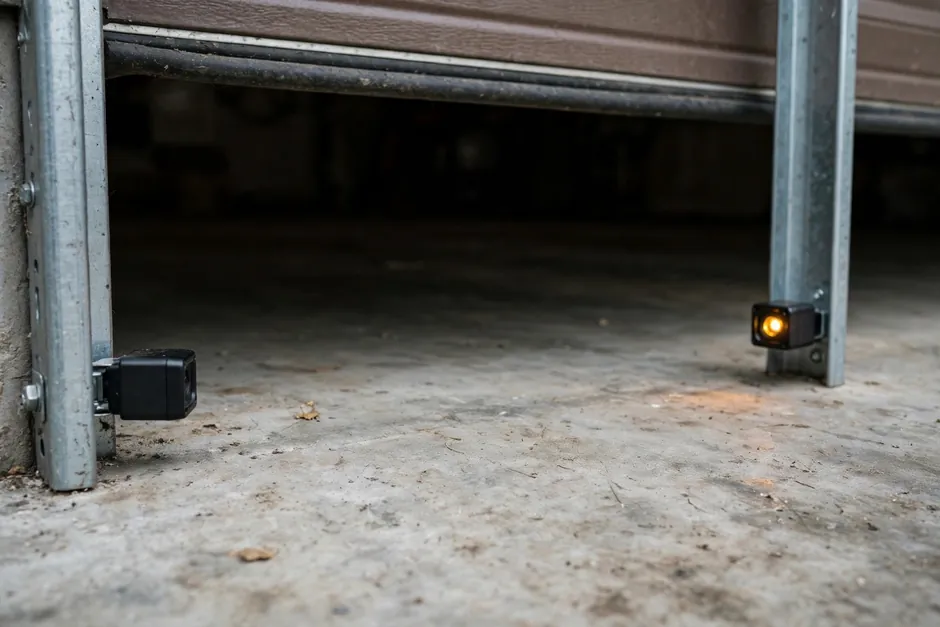
Photo-eye sensors at the base of the door.
About this service
What photo-eye sensors do
Photo-eye sensors are a pair of small units mounted low on each side of the garage door, usually no more than six inches above the floor. One sends an invisible beam across the doorway and the other receives it, and if that beam is broken while the door is closing, the door should stop and reverse.
When we get a call about sensors, the story is often the same: the door opens fine, but it will not close, or it starts down and then jumps back up. The remote is fine, the motor sounds normal, and nothing looks broken. In those cases the sensors are a strong suspect, because the opener is doing exactly what it is built to do when it cannot see a clear beam.
Goodlettsville homes in ZIP 37072 include garages across both Davidson County and Sumner County, and a lot of them sit near I-65 or US-31W, where dust, pollen, and road grit build up fast. A film of grime on a sensor lens, a bracket knocked by a bike tire or a bin, or a wire nicked during a tidy-up can all break the beam. Goodlettsville Garage Door Rescue serves areas such as North Pointe and Union Hill, and the sensor checks are the same in each place.
Sensor work is kept separate from general opener repair here on purpose: the motor, gears, and circuit board are a different problem from the beam at the base of the door. If your remotes have also stopped working, remote programming may be part of the visit, and a tune-up and maintenance visit can catch track and roller problems that make the door shudder and knock sensors out of line.
- ✓ Sensor lenses cleaned and checked
- ✓ Brackets realigned so the beam is true
- ✓ Wiring checked from sensor to opener
What is included
What sensor repair includes
Sensor repair is a focused job. It starts with the beam itself, then works outward to brackets, lenses, and wiring, so you are not paying to replace an opener that was never at fault.
✓
Alignment check
Each sensor is adjusted until the beam runs straight across the doorway and both indicator lights show a steady state.
✓
Lens cleaning
Dust, pollen, cobwebs, and grime are cleaned from the lenses, since even a thin film can weaken or block the beam.
✓
Wiring check
Wires from each sensor back to the opener are checked for breaks, loose connections, and staples that have pinched the cable.
✓
Safety reverse test
The door is closed with the beam broken and with an object in its path, to confirm it stops and reverses as it should.
How it works
How a sensor repair visit usually goes
A sensor visit is usually short, because the fault is often visible once you know what to look for. The steps below are the order we work through, from the simplest cause to the wiring behind it.
01
Lights first
We read the indicator lights on each sensor, since steady, blinking, and dark lights each point to a different fault.
02
Clean and realign
Lenses are cleaned, brackets are straightened, and sensors are aimed until the beam holds steady.
03
Wiring traced
If the lights stay dark or flicker, wiring is traced from the sensor to the opener for breaks or loose terminals.
04
Parts swapped if needed
A cracked housing or a failed sensor is replaced with a matching unit, then aligned and tested.
05
Full close test
The door is run through several full closes, including a blocked beam test, before the visit ends.
Know your options
Is it the sensors, or is it the opener?
Sensor faults and opener faults can look alike from the driveway, because both can leave you with a door that will not close. The clues are in the lights, the wall button, and how the door behaves.
| Clue | Points to sensors | Points to the opener |
|---|---|---|
| Sensor lights | Blinking, dark, or flickering | Both lights steady |
| Wall button held down | Door closes while held | Door still will not close |
| Door movement | Starts down, then reverses | No movement, humming, or grinding |
| Remote | Remote opens, but close fails | Remote does nothing at all |
Holding the wall button down to force a close is a useful clue, not a long-term fix, and it should not be used to bypass the safety system. Maker guidance on sensor lights and alignment, such as the Chamberlain support pages and LiftMaster support pages, can help you read your own indicator lights before you call.
Ready when you are
Door reversing or refusing to close?
Call and tell us what the sensor lights are doing. That detail alone often tells us whether it is alignment, wiring, or something else.
Call to fix it: (615) 805-0680 → Honest cost framing
What does sensor repair usually cost?
Most repairs typically fall in the $129 to $299 range, and sensor repair often sits in that range when the fix is cleaning, realignment, or a wiring repair rather than a larger opener job.
The final figure depends on whether a sensor needs replacing, how much wiring needs tracing or repair, and whether the brackets or mounting have been damaged. You will get the cause and the scope explained before work starts, so a simple alignment is not billed as a bigger job.
01Alignment or cleaning
The simplest sensor fixes, when lenses and brackets are the only problem.
02Sensor replacement
A cracked or failed sensor unit adds the part cost to the visit.
03Wiring repair
Tracing and repairing damaged or loose wiring takes more time than a realignment.
04Opener fault found
If testing shows the opener itself is at fault, the scope changes and is explained before work starts.
Local service
Sensor repair across Goodlettsville
We fix sensors across Goodlettsville, TN 37072, including Twelve Stones Crossing and Madison. Goodlettsville sits about 15 miles north of downtown Nashville, served by I-65 exits 96, 97, and 98 and by US-31W, and its humid summers mean pollen and dust on sensor lenses are a regular cause of false reversals here.
Before you call, check the small lights on each sensor and note whether each one is steady, blinking, or dark. Also note whether the door closes when you hold the wall button down. Those two facts help narrow the fault fast.
Blinking lights usually mean the sensors are out of alignment or one sensor is not receiving the beam. A steady light on one side and a blinking or dark light on the other often points to the receiving sensor or its wiring.
You can gently wipe the lenses and check that the brackets are straight and firm, but avoid forcing brackets or touching wiring if you are unsure. If cleaning and a careful realignment do not fix it, the fault may be in the wiring or the sensor itself.
Holding the wall button can bypass the sensor safety check on many openers, which points strongly to a sensor fault. It is a useful clue for diagnosis, but it should not be used as a daily way to close the door.
Close the door, then break the beam with your hand or an object before the door reaches the floor, and the door should stop and reverse. A second check is placing a solid object in the path, since the door should also reverse on contact.
Ready when you are
Get your sensors fixed and your door closing again
Call and describe the sensor lights and what the door does when you try to close it.
Call to fix it: (615) 805-0680 → Get in touch
Call to book a visit
Call to describe the sensor lights and the door behavior, and book a visit. You can also email the office, and we will call you back during business hours.
Call(615) 805-0680Email the officeinfo@goodlettsville.garagedoorrescue.us
Office hoursMon-Fri, 8:00 a.m. to 6:00 p.m.
Address2208 Ted Dorris Rd, Goodlettsville, TN 37072